


The Pigs of Big Jack Mountain
The pigs of Big Jack Mountain
On the 19th June, 2026, we said goodbye to Eamon, the last of three pigs who came to us in the summer that much of eastern Australia caught fire. With him gone, it feels like the right time to tell you their whole story, Clovis, Basil and Eamon, because it has sat with me for six years now, and because it says something I think is worth saying out loud.
The summer of 2019 into 2020 is one a lot of us would rather forget and none of us can. The drought had gone on so long that the ground itself seemed to have given up. Everything was tinder. For weeks the Tallaganda State Forest burned not far from us, and every day it crept a little closer to the sanctuary. We watched the maps, we watched the sky, and at one point we evacuated nearly every animal we had, because it looked for all the world as though nowhere on the eastern side of the country was safe. It is a particular kind of fear, standing on land you love with hundreds of lives in your care, not knowing if it will still be there in the morning.

The wildlife losses that season were beyond counting and devastating to witness, but seeing how many people stepped up to help was something we held onto. People mobilised. Carers went in, set up triage, drove for hours with formula and treatments for burns and soft bandages. The koalas and the kangaroos and the possums who survived had, at least, a chance, because enough people decided they mattered.
I want to tell you about the animals who did not get that response.
Farmed animals, in a fire, are not counted the way wildlife are. In the language of the system that owns them, they are livestock. Stock. Items on a ledger, covered by insurance, replaceable. When fire comes through, the response for surviving farmed animals is rarely rescue and recovery. More often it is a bullet, because caring for a badly affected animal is slow and expensive, and because the sheer number of animals held in commercial farming makes individual care a logistical impossibility. That summer we offered our help to provide this care for farmed animals to anyone who would take it, the councils, the DPI, the Local Land Services. We had seen the devastation up close, we were living under the threat of it ourselves, and we desperately wanted to do something. But the animals were being shot, and there was very little a small sanctuary could do to change that. It was one of the most helpless feelings I have known.
And then we heard about three pigs on Big Jack Mountain.
They had lived their entire lives on that mountain, cared for by an elderly man who, as the years caught up with him, had moved them into a smaller area so he could look after them more easily. When the fire came through, it took everything. The family's house, their cars, the pigs' enclosure, all of it gone. In the middle of that loss, three terrified pigs were somehow still alive. Clovis, we later learned, had leapt twice his own height to get out as the fire bore down, and was found hiding under a nearby church, one of the few buildings the flames had spared. The three of them were singed and frightened out of their minds, and yet, against every odd, otherwise unharmed.
There was nowhere secure left for them. No enclosure, no one on site able to care for them, and the recommendation on the table from local authorities was the usual one. They were to be shot. We heard about their plight and did not have to think very hard about what to do.
What followed was a nine hour round trip and some of the hardest loading we have ever done. The pigs were terrified, and terrified pigs do not want to go anywhere, least of all up a ramp into a float with strangers. It took hours. Our hearts ached the whole time, for what they had already been through and for how frightening this rescue must have felt to them, even as it was the very thing that would save them.
When we finally made it home, one of them refused to come off the float for the longest time, and we let him take it at his own pace. The other two caught sight of a wallow, and the heat of the day did what no amount of coaxing could. Out they came, straight into the cool of the mud, and the wallowing began. If you have never watched a pig sink into a wallow, I can tell you it is one of the most contented sights in the world, and after everything they had survived, it undid me a little.

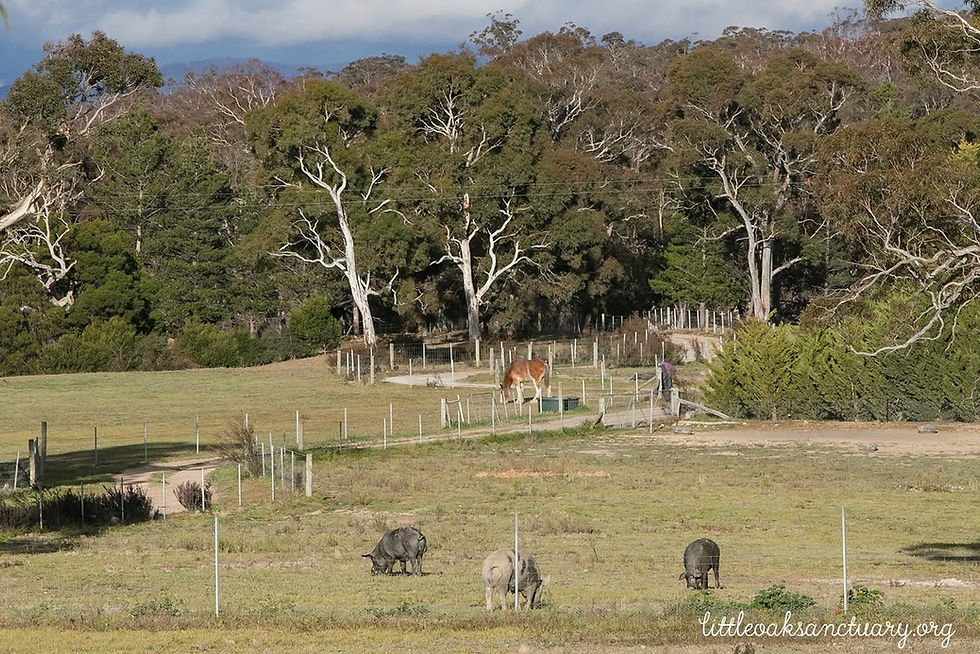
For the first while, the three of them mostly slept. Their bodies and their minds had been pushed well past what any animal should have to bear, and rest was the medicine they needed most. Slowly, over the following weeks, they came back to themselves. They wallowed every day. They bounded around their paddock together like the friends they had always been. They fell upon their twice daily meals of grains and fruit and vegetables with the enthusiasm of pigs who had decided, at last, that they were safe.

They were already nine years old when they arrived, on the older end of pig years, and we knew our time with them was unlikely to be long. We got six years. Clovis was the first to leave us, three years ago now. Basil followed, two years ago almost to the day. And on Friday, when we came to bring Eamon his dinner, he did not get up. He had settled into his shelter for what looked like an ordinary afternoon nap, his snout tilted up into the gentle winter sun, and at some point in that warmth he had simply slipped away. There was no rise and fall to his chest when we found him. For a pig who had survived so much, we could not have wished him a gentler ending than that.

I tell you all of this not to leave you heavy, though I know it might. I tell you because Clovis, Basil and Eamon were never just stock. Whatever the system that owned them called them, they were three individuals with a lifelong friendship, a favourite way to spend a hot afternoon, and six good years on the far side of the worst day of their lives. The only thing that stood between them and the countless farmed animals who were shot that summer was that, for once, somebody came.
That is the whole of it, really. That is what a sanctuary is. Somebody coming, when the system says don't bother.
Rest easy, boys. We were so lucky to know you.


Comments